


Last week, I started a conversation to answer the question, “What is Simple Church?” At the core, Simple Church is not a program for a church to run, but a way of thinking about and organizing the people within a church to facilitate covenant relationships and activate the church for disciple-making and evangelism.
The question remains: What is a Simple Church, and for our tactically oriented Western minds, what does a Simple Church do?
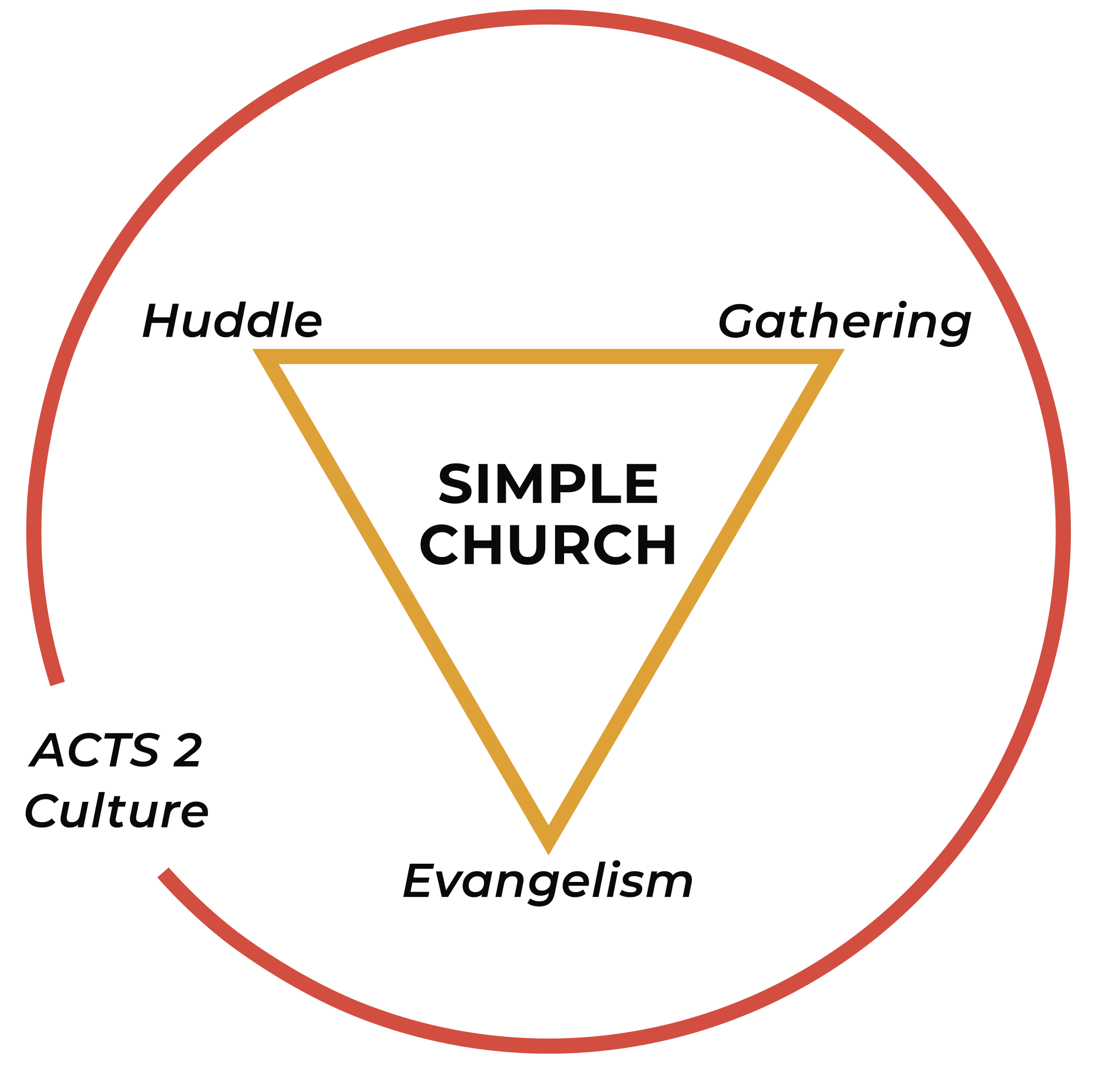
A Simple Church is made up of two primary components: the circle and the triangle. Or, more accurately, the triangle inside the circle. The circle represents the culture that connects and integrates the Simple Church, and the triangle represents the core weekly rhythms that ground the Simple Church.
For us, that means the circle of Acts 2 Culture and the three weekly rhythms of Gathering, Huddle and Evangelism.
The Circle: Acts 2 Culture
The circle of Acts 2 Culture is the most important component of Simple Church, though the triangle of Huddle, Gathering and Evangelism tends to get more attention, as it’s easily identifiable.
What do we mean by Acts 2 Culture? We see Acts 2 as the blueprint for the church, not just an idealistic era that we have moved beyond. Acts 2:42–47 describes the core form of the church that Simple Churches are called to embody. Simple Churches can measure their success by their willingness to live into the culture.
We have codified Acts 2 Culture into six “everyday practices”:
Spiritual Hunger: The genuine desire to know God and walk in relationship with him. Our Daily Devos (daily Scripture study) is the primary tool we use to cultivate this hunger. A culture centred on God’s Word is a culture that will inform all the other components.
Church at the Centre: The commitment to covenant family relationships and the decision to build our lives around our church family, rather than exclusively around our biological families, careers or other factors.
Sacrificial Living: The decision to live humbly to serve others, including our Simple Church, our wider church family, and those who do not know Christ.
Open Home: We invite people into our homes as part of the natural rhythm of living on mission. We see our homes as tools to bless others instead of a place of private refuge.
Intentional Proximity: Actively living lives that are integrated with our church family through the intentional sharing of space, time and resources. Proximity starts by living close together, but extends beyond that to intentionally integrating our whole lives with our covenant brothers and sisters.
Passion for the Lost: Seeing those outside the family of God invited in is not just an activity we do (evangelism), but a passion we cultivate. By praying for and living lives dedicated to expanding the family of God, we live with evangelism as a central mission, not just a side hustle.
The culture must precede the tactical rhythms. Otherwise, a Simple Church can end up stuck in a rut of monotony that is disconnected from the vision.
The Triangle: Weekly Rhythms
If the above practices serve as the wraparound culture, the triangle serves as the grounding rhythms:
Huddle: Weekly time in Scripture to foster new relationships, provide a context to discuss questions, share burdens and invite non-believers to explore faith. Huddle is the most natural weekly invitation point to start and grow relationships within a Simple Church.
Evangelism: We divide evangelism into serving-focused initiatives and Gospel-sharing initiatives. The serving initiatives tend to focus on addressing physical and relational needs as a vehicle to share the Gospel and invite non-believers into the context of serving alongside Christians. Gospel-sharing initiatives include cold-contact evangelism, events and weekly hangouts.
Gathering: Every week, all the Simple Churches gather together with the other Simple Churches in the city to sit under God’s Word and worship. The Gathering is essential because it provides a minimal weekly touchpoint to reconnect with members of Simple Churches that have multiplied, whom you were formerly close with but now see less frequently.
Interestingly, we find that nominal Christians prefer the Gathering as their primary entry point into the church, whereas non-Christians prefer Huddle or serving initiatives.
Simple Church Is More Than Its Rhythms
The key point:
The blend of attending to a culture while anchoring in specific rhythms is perhaps the part that makes Simple Church unique.
Simple Churches DO three things a week. But they are not those things. For example, Huddle is not Simple Church any more than a church service is the church. The church is a covenant family of relationships on a mission. Likewise, a Simple Church is just a minimal expression of that principle lived out.
There is a lot more to be said about how Huddle, Gathering and Evangelism work in the details, which I will unpack in future weeks.